

The number of international students studying inKorea has surpassed 320,000. In whichregions, fieldsof study, and countries are their numbers growing?
The Ministryof Justicerecentlyreleaseddata on 530,000 international students who enteredKorean universities between 2019 and 2025.Based on this data, TalentLink analyzed how international studentadmissions changed over the past six years.
🎯 Changes in International Student Admissions: 4KeyFindings
In 2025, 117,333 new international studentsenrolled,a75% increasefrom66,915in 2019.Overthesame period, total university admissions, includingKorean students,fellby1%,from 733,517to 729,306.
International student admissionsfell to44,902 in2020when COVID-19began, but then increased every year without interruption. They reached77,000 in2023,96,000 in 2024, andsurpassed 110,000 forthefirst timein 2025. The figuresconfirmthat international students are filling places at Korean universities left vacant by the declining school-age population.
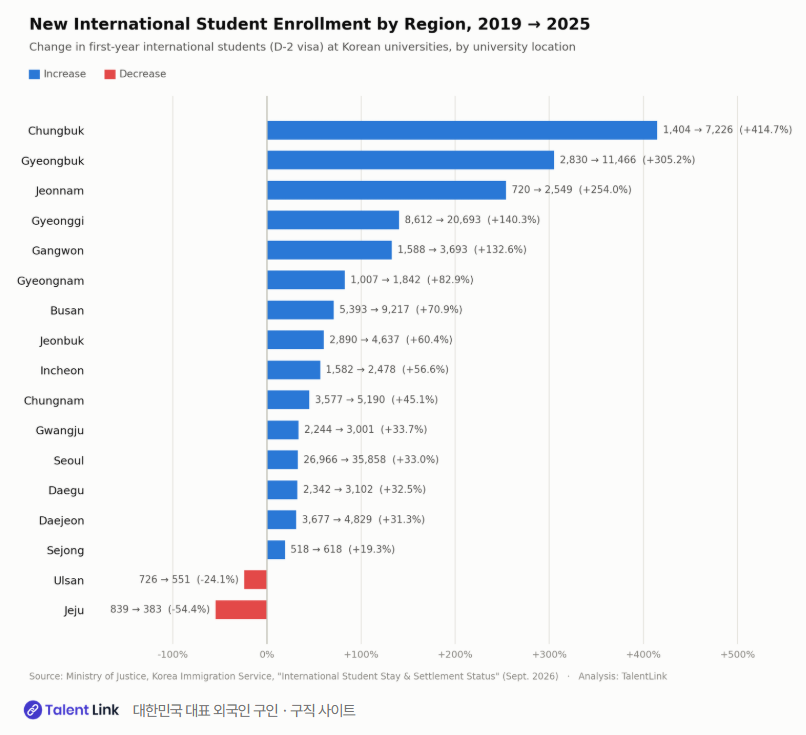
By region, international studentadmissionsroseparticularly sharply in Chungbuk, Gyeongbuk, Jeonnam, and Gyeonggi.Chungbuk grewmore thanfivefold, from1,404 to7,226,while Gyeongbukgrewmore thanfourfold, from2,830to 11,466.Internationalstudents in Chungbuk areconcentratedin medicine,pharmacy, andengineering, while those in Gyeongbuk are concentrated in medicine and pharmacy.
Seoul still receives the largest numberofinternationalstudents (35,858),but its 33% growth rate isbelow the national average. Ulsan andJeju,meanwhile, are the only regions where international student admissions declined. The most notablefeature of the data is that the center of international student recruitment is shifting from the Seoul metropolitan area to regional hubs.
By field of study,medicineand pharmacy grewfourfold (+296%),whileengineeringgrew 2.4 times (+138%), recording the fastest increases. Growthwas especially notable inclinicallaboratory science, nursing, care services, and semiconductor-related departments. Thissuggeststhat Korea’s demand for care workers and advanced-industry talent is driving the influx of international students.
Field of Study | 2019 | 2025 | Change |
|---|---|---|---|
Medicine and Pharmacy | 713 students | 2,826 students | +296.4% |
Engineering | 9,114 students | 21,675 students | +137.8% |
Social Sciences | 28,220 students | 53,649 students | +90.1% |
Natural Sciences | 3,081 students | 5,244 students | +70.2% |
Education | 1,247 students | 2,073 students | +66.2% |
Arts and Sports | 7,426 students | 11,521 students | +55.1% |
Humanities | 17,113 students | 20,345 students | +18.9% |
In terms of overall size,however,social sciencesremain dominant with 53,649 students, followedbyengineeringwith 21,675andhumanitieswith 20,345. Humanitiesgrew by only19%,showing relative stagnation compared with other fields.
By nationality, China(36,021)and Vietnam(26,415)rankfirst andsecondbya widemargin,followedbyUzbekistan(8,942),Nepal(7,612),and Mongolia (5,366).
The picture changes when growthratesareconsidered.Compared with 2019,Myanmar grewmorethan ninefold(+828%) and Nepal morethaneightfold (+768%). Vietnam(+197%), Bangladesh(+172%), andMongolia(+97%) alsoroughly doubled or more.China, the largest group,grewby only 28%.
Category | Country | 2025 Admissions | Change from 2019 |
|---|---|---|---|
Largest Groups | China | 36,021 students | +28.0% |
Vietnam | 26,415 students | +197.2% | |
Uzbekistan | 8,942 students | +153.0% | |
Nepal | 7,612 students | +768.0% | |
Mongolia | 5,366 students | +96.7% | |
Highest Growth | Myanmar | 2,950 students | +827.7% |
Bangladesh | 1,490 students | +172.4% |
Nepal and Vietnam rank highly in both size and growth,makingthem likely to become central to the future composition of internationalstudents in Korea. A student population once centered on China is rapidly diversifying toward Southeast and South Asia.
⚠️Note
The figures in this article arebased on the “Residenceand SettlementStatusof International Students” published by the KoreaImmigration Service of the Ministry ofJusticein September 2026.The Ministryof Justice counts only holders of Student (D-2) visasas international students, while the Ministry of Education’s “Basic Education Statistics” counts all enrolled foreign nationals regardless of visa type. The two statistics may therefore report different numbers of international students.


