
How Long to Get an F-5 Visa? 4 Permanent Residency Pathways for International Students.
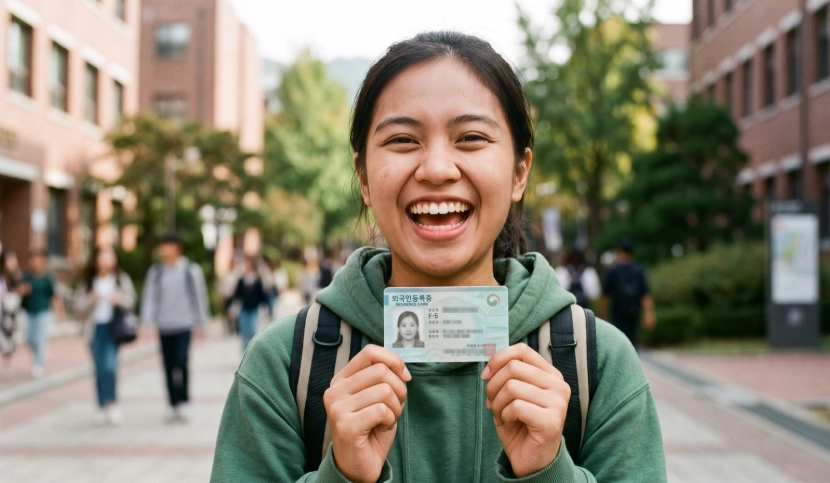
"Can I stay in Korea even after I graduate?"
International students who graduate from a Korean university — for every 10 of them, 7 eventually leave Korea. Even if they want to stay, many miss their chance simply because they don't know which visa to switch to after graduation in order to eventually qualify for permanent residency.
A Student visa (D-2) leading to Permanent Residency (F-5) can take several different paths. Depending on which visa you choose right after graduation, the time it takes international students to get permanent residency can vary — anywhere from3 to 5 years.
🗺️ International Students' Permanent Residency Paths at a Glance — 4 Routes
Your Situation | Visa Right After Graduation | Interim Stage | Until Permanent Residency (F-5) |
|---|---|---|---|
Science & Engineering Master's · PhD (K-STAR participating university) | K-STAR Residency (F-2-7S) | 3 Years of Stay | About 3 years |
Professional Job Secured Around Graduation | Points-Based Residency (F-2-7) Direct route (Master's degree or higher) or Specific Activity (E-7-1) | F-2-7 status — 3 years of stay | About 3~4 years |
Still Job Hunting | Job-Seeking (D-10) | E-7 Full-Time Employment — 3 years of work | About 4 years |
Wants to Settle in a Population-Declining Region | Region-Specific Residency (F-2-R) | F-2 status — 5 years of stay | About 5 years |
※ The periods above are approximate timelines calculated from the point of graduation, they vary depending on processing times and individual circumstances.
Path ① If You Hold a Science & Engineering Master's · PhD Degree, K-STAR Visa TrackK-STAR is a program involving 32 universities selected by the Ministry of Justice, where university presidents recommend talented Science & Engineering Master's·PhD international students with outstanding research capabilities. Regardless of employment status, it first grants a Residency (F-2-7S) visa, allowing a stay of up to 5 years with no income requirement. F-2-7S status allows you to stay 3 years, and once you meet research-performance-based point requirements, you apply for Permanent Residency (F-5). Among the four paths, this is the fastest way to reach permanent residency. Path ② Your Job Is Already Secured, the Goal Is F-2-7If you have a Master's degree or higher, you can switch directly to Points-Based Residency right at graduation (F-2-7) status. This applies if you earned a regular Master's degree in Korea, and your combined time on Student·Job-Seeking visas totals 3 years or more, with a professional job already secured. The points-system requires 80 points or more, and having a Korean Master's degree adds bonus points. If you only have a Bachelor's degree, you first work on a Specific Activity visa (E-7-1). E-7-1 holders must normally switch to F-2-7 only after working 3 years, but if your annual income reaches 40 million won or more, that 3-year requirement is waived. In other words, once your income qualifies, an earlier switch becomes possible — as early as around year 1 of your stay. If your income falls short of this, you can instead stay on E-7 status and, after completing 3 years, follow Path ③ by applying directly for Permanent Residency (F-5). F-2-7 status has a major advantage: it isn't tied to a specific employer, so switching jobs freely is possible. F-2-7 status for 3 years leads you to apply for Permanent Residency (F-5). Path ③ If You Haven't Found a Job Yet, D-10 to E-7 TransitionIf your job isn't secured by graduation, you can switch to a Job-Seeking (D-10) visa and continue your job search for about 1 year. With permission, you can also build experience through internships or part-time work. After that, on an E-7 visa, working a regular·full-time job for 3 years continuously, you apply for Permanent Residency (F-5). If you're on a fixed-term contract or have long gaps in employment, there's a risk the 3-year requirement won't be recognized, so plan job changes carefully to avoid creating gaps. Path ④ If You Want to Settle in the Regions, Region-Specific F-2-RRegion-Specific Residency (F-2-R) is a path that starts right after graduation with a residency visa recommended by a metropolitan/provincial governor. The basic requirements are income at or above the living wage and TOPIK 3 or higher. In return, you're required to live in a population-declining region for 5 years. F-2 status for 5 years of stay leads to applying for Permanent Residency (F-5). It's the longest path, but a stable option if you plan to settle in the region. |
⚠️ Notes
• Income·points criteria, along with K-STAR participating universities, change every year, so check the latest standards at HiKorea or your local Immigration·Foreign Affairs Office before applying.
• All status-of-stay changes must be applied for before your current stay period expires.