
Why Can't Foreigners Take Just Any Job? The Reasons Behind Visa-Based Employment Restrictions for Fo
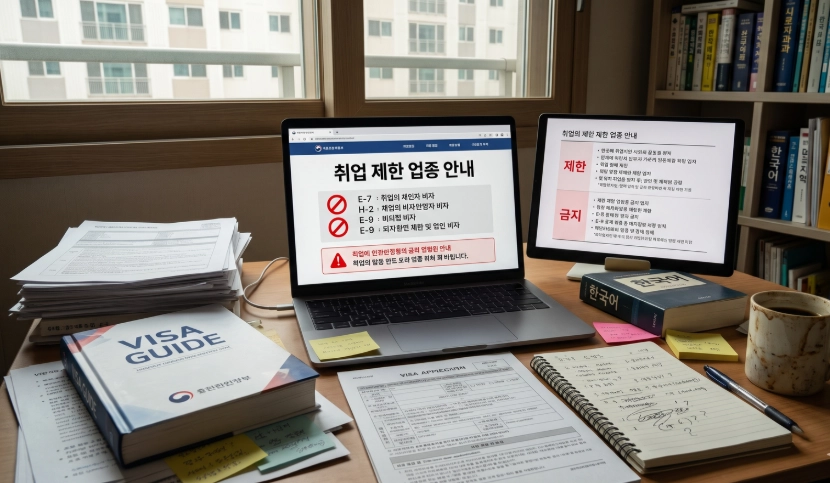
"My Korean friend works part-time doing deliveries, why can't I?"
International students can't do delivery or construction-site jobs, and E-7 visa holders must work only in designated occupations. Since the work you can do depends on which visa you hold, even for the same person, it is only natural to feel that it's unfair.
But this system was not created to discriminate against foreigners. In this article, we look at why employment restrictions on foreigners exist and walk through the reasons step by step.
Employment restrictions on foreigners: Is it only Korea?
Most countries that accept foreigners operate similar systems.
Country | Key system | Key details |
|---|---|---|
Japan | Permission for activities outside status of residence (international students) | Part-time work allowed only with permission, up to 28 hours per week, no work at entertainment venues |
United States | Specialty occupation work visa (H-1B) | Only occupations requiring specialized knowledge at a bachelor's level or higher are allowed, employers must promise wages at or above the level of U.S. workers doing the same job |
Canada | Labour Market Impact Assessment (LMIA) | Reviews the impact of hiring foreigners on Canada's labor market, employers must prove their efforts to hire citizens |
Korea | Employment Permit System (EPS) | Before hiring a foreigner, employers must make recruitment efforts for Korean workers for a set period |
The methods differ slightly from country to country, but the criteria are similar. They come down to two things: protecting jobs for a country's own citizens and the national interest.
Reason ① To protect jobs for its own citizens
Every government is responsible first and foremost for the livelihoods of its own citizens. Jobs are limited, and simple work that needs no special skills in particular is a job that many domestic workers, such as young people, older adults, and low-income earners, depend on to make a living.
If foreign workers enter this field without limits, domestic workers risk losing jobs or seeing their wages fall. In its own assessment, the Canadian government also pointed out that in some industries and regions, hiring foreigners can push out domestic workers or drive wages down.
So each country follows the principle of "look for domestic workers first, and hire foreigners only when none can be found"", and sets standards so that even when foreigners are hired, they cannot be paid less than domestic workers doing the same job.
This wage standard matters for foreigners too. That is because it also serves as a safeguard against foreign workers being used as 'cheap labor'.
Reason ② To see whether it serves Korea's national interest
A visa is a blueprint for bringing the people a country needs to the places where they are needed. This is why the occupations allowed differ from visa to visa.
Professional visa (E-7) is for people with specialized knowledge who can strengthen the competitiveness of Korean companies. Non-professional employment visa (E-9) is for filling labor shortages in manufacturing and agriculture and livestock, where Korean workers are hard to find. Recently, visas tailored to what the country needs keep emerging, such as the K-STAR visa track that favors science and engineering master's and doctoral degree holders, and the region-specific residence visa that helps people settle in population-declining areas (F-2-R).
If anyone could do any job, these policy goals would be hard to achieve. Job restrictions by visa are easy to understand as the country's message saying "Korea needs this kind of talent in this field".
There are other reasons too
· First, to protect the purpose for which the visa was issued. A visa is issued according to the purpose of entry. Student (D-2) visas are meant for study, so part-time work is allowed only to the extent that it does not interfere with studies. Japan likewise sets a condition for student part-time work: 'it must not interfere with study'. If a student visa becomes a back door to employment, even diligent students who study sincerely come under suspicion. · Second, to protect foreign workers. There are fields, such as entertainment venues or sites with poor safety management, where exploitation and accidents are likely. Doing such work without knowing Korean or the law makes it hard to be properly protected even if you are harmed. This is also why the Canadian government describes the Labour Market Impact Assessment as the first safeguard for protecting foreign workers. |
Employment restrictions on foreigners are not discrimination but a process of building trust
The more you study in Korea, work, and pay taxes while building up your period of stay, the wider the range of work you can do.
From Student (D-2) to Professional (E-7), then through Resident (F-2) to Permanent Resident (F-5), most employment restrictions almost disappear. Resident·Permanent Resident·Marriage Immigrant visa holders can work much like Korean citizens, because they are regarded as settled members of Korean society.
Staying within the scope allowed by your current visa is the fastest way to move up to the next stage.
Written by: TalentLink (Job Platform for Foreigners)