
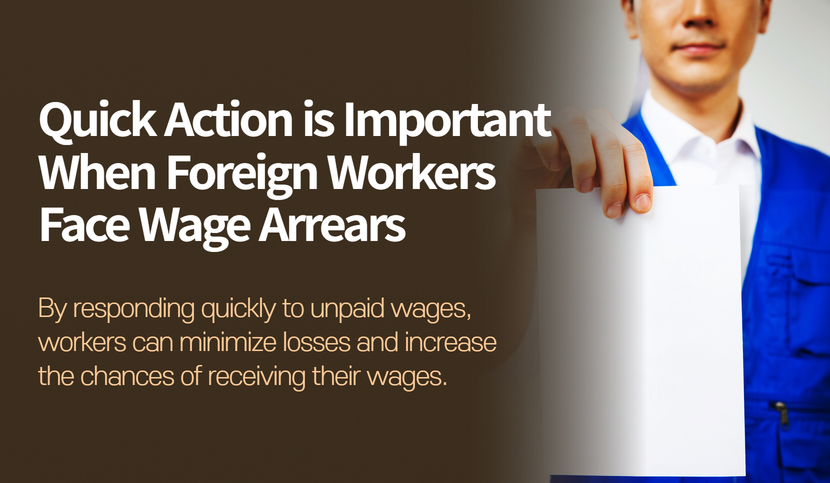
As the number of foreign workers in Korea increases, unfortunately, wage arrears have also become a frequent issue. Wage arrears are separate from visa status, and even if a worker is staying illegally, they still have the legal right to claim unpaid wages.
Many foreign workers fail to respond properly due to language barriers and a lack of understanding of the system. This guide explains the practical procedures foreign workers can use when faced with unpaid wages.
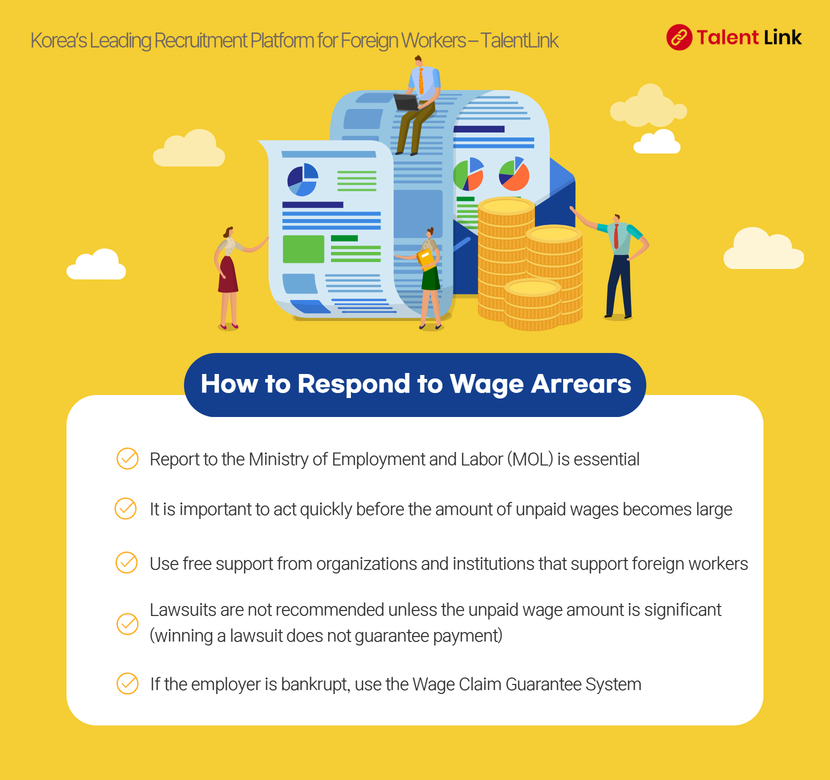
✅ 01. Collecting and Preparing Evidence
You must prove that you actually worked and that wages were not paid. These documents are essential when reporting to the Labor Office, so it is advisable to keep them well organized in advance.
• Employment contract, pay slips, bank account transaction records
• Records of attendance (fingerprint records, timesheets, transportation card usage, etc.)
• Work-related instructions (text messages, messenger records)
✅ 02. Filing a Petition with the Ministry of Employment and Labor
Foreign workers can report unpaid wages to the Ministry of Employment and Labor in the same way as Korean workers.
• Ministry of Employment and Labor Call Center ☎ 1350 (multilingual consultation available)
• File in person at a local Labor Office or submit online complaints수
Once a report is filed, a labor inspector investigates the employer’s violation. If a violation is confirmed, the employer will be ordered to make corrections.
If the worker receives unpaid wages at this stage, it is the best outcome. If not, a separate civil lawsuit must be pursued.
✅ 03. Criminal Charges and Investigation
If the employer still does not pay despite corrective orders, they may face up to 3 years of imprisonment or a fine of up to 30 million KRW. However, it is important to note that even if the employer is criminally punished, this does not guarantee payment of unpaid wages. Sometimes, employers pay the arrears to reduce their punishment, but if they are financially incapable, the worker may still not receive payment.
✅ 04. Civil Lawsuit
If a civil lawsuit is filed, the worker can enforce collection of the employer’s assets after winning a judgment. However, civil lawsuits are difficult for foreigners to pursue alone and usually require interpreters or legal aid. Furthermore, if the employer has no assets, the worker may win the lawsuit but still fail to receive payment.
Therefore, if the amount of unpaid wages is small, pursuing a lawsuit may not be practical. In cases where the employer is legally bankrupt, workers may apply for the Wage Claim Guarantee System instead, which will be introduced separately.
✅ Summary
Even if the employer is punished, it is often difficult to actually receive unpaid wages. Therefore, it is most important to report wage arrears to the Ministry of Employment and Labor before the amount becomes too large. As time passes, the employer’s financial condition may worsen, and the larger the arrears, the more likely the employer will try to avoid settlement or payment.
✅ Related Information
☎️Foreign Workers’ Counseling Center (1577-0071): Multilingual labor counseling
(English, Chinese, Vietnamese, Thai, Mongolian, Uzbek, Cambodian, Russian, etc.)
🔗 Foreign Workers’ Support Centers: Labor, legal consultation, interpretation
🔗 Korea Legal Aid Corporation: Free or low-cost legal support


