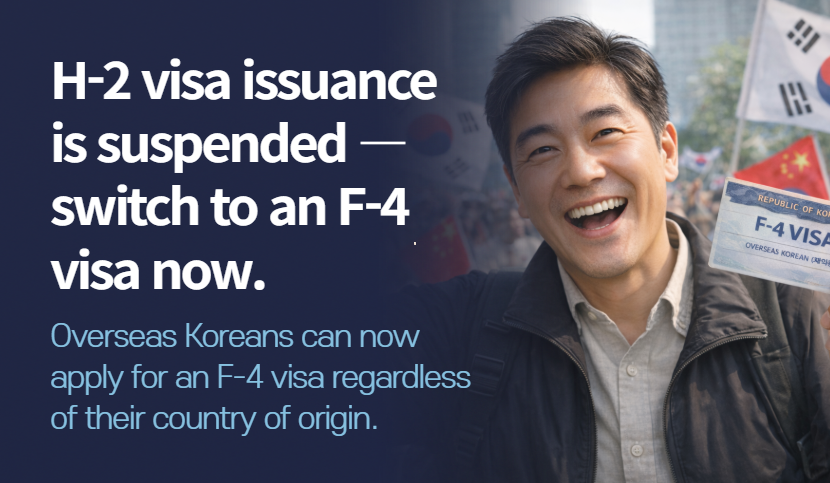
Korea’s Ministry of Justice announced that, starting February 12, 2026, Korea will fully suspend new issuance of the H-2 (Working Visit) visa and consolidate overseas Korean residence statuses into the F-4 (Overseas Korean) visa. Below is a clear summary of what changes under this reform, especially for those who previously faced different rules depending on nationality or personal qualifications
Previously, overseas Koreans from China and six former Soviet states often had to meet requirements such as income, education, and work experience to obtain an F-4 visa. If they did not meet those criteria, they had to apply for an H-2 visa instead. Under H-2, employment was largely limited to non-professional fields such as restaurants, accommodation, agriculture, and manufacturing, and professional employment was generally not allowed.
With the new policy, regardless of nationality or economic status, anyone who is verified as an overseas Korean can obtain an F-4 visa.
Category | Before | After |
Eligibility | If income/education requirements were not met → H-2 | Verification as overseas Korean → F-4 regardless of nationality |
Period of stay | Up to 4 years 10 months, then departure required (re-entry required a separate process) | Continuous extensions possible within Korea |
Family accompaniment | Restrictions on inviting spouse/minor children | More stable family accompaniment/residence possible |
Status-change fee | KRW 100,000 | Waived until the end of 2027 (status-change permission fee only; residence card issuance fee still applies) |
If you already hold an H-2 visa, please note:
① Your remaining stay is protected
② You can apply to switch to F-4 at any time
③ Fee waiver until 2027 |
H-2 limited employment mainly to lower-skilled sectors, while F-4 generally allows work in nearly all fields, including professional occupations such as lawyer, doctor, professor, researcher, and IT developer.
(※Note: employment is still restricted for certain categories of low-skilled/service jobs—approximately 37 occupations.)
Not necessarily. Even if your current workplace falls under an F-4 restricted category, you may be able to continue working at the same workplace by obtaining permission for activities outside your status of stay, allowing uninterrupted employment.
For safe settlement and adjustment, applicants must complete a 5-hour early adaptation program.
• Training topics: Basic law and public order, essential social adaptation information, crime prevention, industrial safety, settlement guidance, etc.
• Exemptions may apply to: - Those currently enrolled in or graduated from Korean elementary/middle/high school - Under age 6 or age 65+ - Those who have stayed in Korea for 3+ years under long-term status - Those who already completed the program or completed Social Integration Program Level 1+ - Persons with severe disabilities, etc. |
🌟Closing
This reform is a significant step toward correcting long-standing inequities in overseas Korean visa policies. It will be especially welcome news for those who have faced limitations under H-2.
To take advantage of the fee waiver, be sure to apply for the switch to F-4 before December 31, 2027.