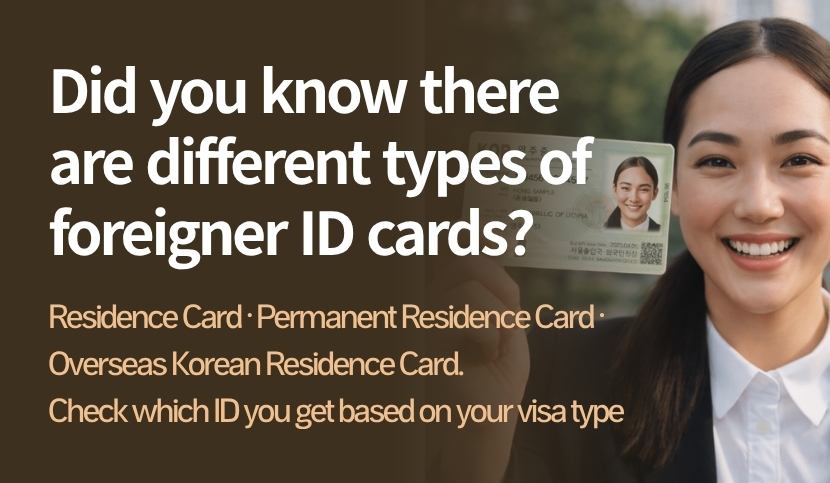
If you stay in Korea for more than 90 days, you must obtain a residence card. However, not all foreigners receive the same type of card.
Check the differences between the three types of ID cards: Residence Card, Permanent Residence Card, and Overseas Korean Residence Card.
Card Type | Eligible Applicants | Color | Validity |
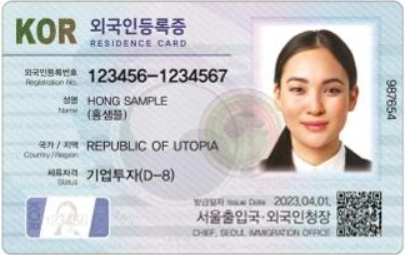
Residence Card | General foreigners (excluding F-5, F-4) | Blue | Depends on visa |
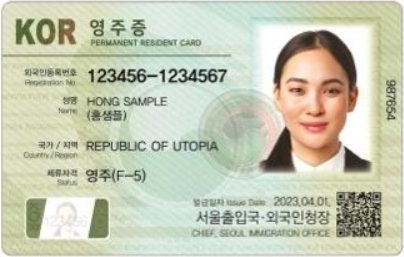
Permanent Residence Card | F-5 visa holders | Green | 10 years |
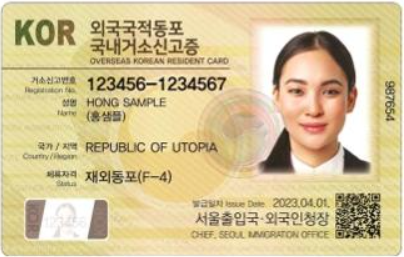
Overseas Korean Residence Card | F-4 visa holders | Yellow | 3 years |
This is the ID card issued to most foreigners staying long-term in Korea.
It applies to various statuses such as students (D visa), workers (E visa), and marriage migrants (F-6).
• All foreigners except F-5 (permanent residents) and F-4 (overseas Koreans)
• Must apply at the immigration office within 90 days from entry; validity depends on visa status
F-5 permanent residents are issued a separate permanent residence card instead of a general residence card.
• Foreigners with F-5 visa
• Issued immediately upon obtaining permanent residency; must be reissued every 10 years
Issued to overseas Koreans who previously held Korean nationality but acquired foreign citizenship, instead of a residence card.
• Overseas Koreans with F-4 visa
• Must apply within 90 days after entry; valid for 3 years (no limit on extensions)
✅ Same legal function as identification
Although the types differ, all cards can be used equally for most administrative and financial procedures in Korea.
• Opening bank accounts and financial transactions
• Mobile phone registration
• Health insurance enrollment
• Issuance and reissuance of driver’s licenses
❓FAQ
Yes, it can be used as a substitute in administrative procedures and transactions under the law.
Yes. The visa itself remains valid, but failure to renew the card may cause disadvantages, so the expiration date must be checked.
Yes. When your visa changes, you must reissue the appropriate card. For example, changing from a student visa (D-2) to a work visa (E-7) requires a new residence card, and changing to permanent residency (F-5) requires returning the old card and receiving a permanent residence card.